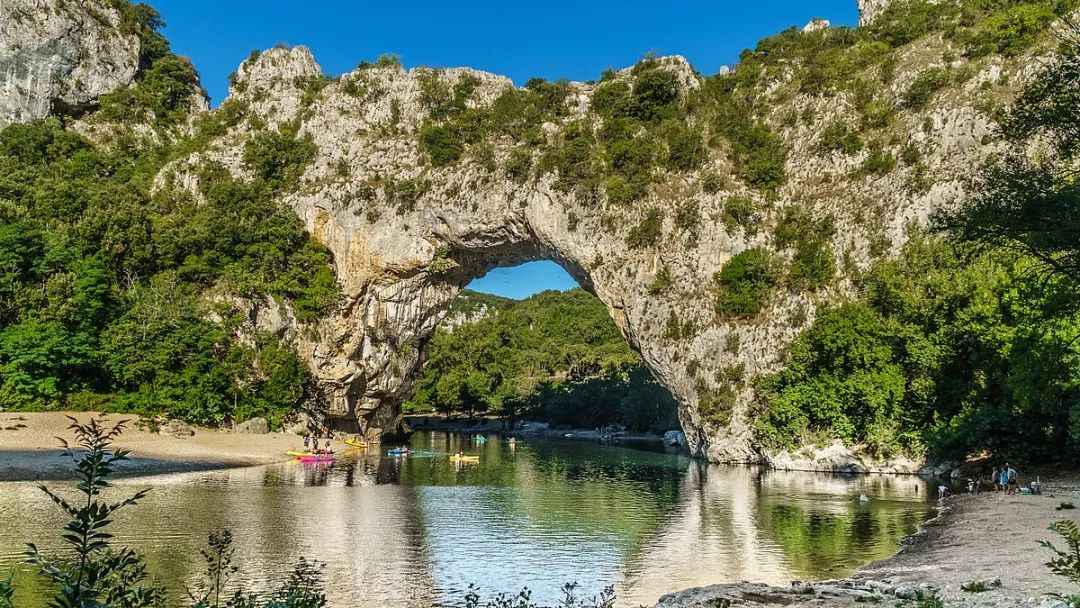
Nestled beneath the natural limestone arch of Pont-d'Arc in France's Ardèche region, the Chauvet-Pont-d'Arc Cave (Grotte Chauvet-Pont-d'Arc) stands as a UNESCO World Heritage Site and one of humanity's most profound artistic treasures. This geological marvel shelters a trove of Paleolithic masterpieces that redefine our understanding of early human creativity.
Nestled beneath the natural limestone arch of Pont-d'Arc in France's Ardèche region, the Chauvet-Pont-d'Arc Cave (Grotte Chauvet-Pont-d'Arc) stands as a UNESCO World Heritage Site and one of humanity's most profound artistic treasures. This geological marvel shelters a trove of Paleolithic masterpieces that redefine our understanding of early human creativity.
On December 18, 1994, explorers Jean-Marie Chauvet, Eliette Brunel Deschamps, and Christian Hillaire uncovered an entrance sealed by rockfalls for 23,000 years. Their headlamps revealed the "Lion Panel"—a 30-foot mural depicting 13 cave lions in dynamic pursuit of bison, rendered with overlapping perspectives and lifelike musculature. Radiocarbon dating confirmed the oldest paintings, including rhinoceroses and mammoths, date back 36,000 years to the Aurignacian period—nearly twice as old as Lascaux Cave.
The cave's 8,500 sq.m walls host over 1,000 artworks showcasing advanced techniques:
- Anatomical precision: Woolly rhinos are shaded to appear three-dimensional
- Natural integration: Artists used stalactite formations to contour running horses
- Symbolic power: 425 handprints and child-sized footprints suggest ritual significance
Notably, the "Megaceros Gallery" features volcanic eruption depictions possibly documenting a 43,000-year-old event at nearby Bas-Vivarais—a testament to early humans' observational prowess.
To preserve the fragile environment, the original cave remains closed to the public. Only scientists in full-body suits may enter twice annually. However, a €55 million replica, Caverne du Pont-d'Arc, opened in 2015. Using 160 million laser-scanned data points and 6,000 high-res images, it recreates the cave's microclimate, including temperature, humidity, and even scent. Visitors can explore recreated chambers with 1,000 painted panels and 450 fossilized animal remains. In 2020, MIT's robotic system Scribit brought Chauvet's art into homes globally, blending ancient heritage with modern technology.
Chauvet's significance extends beyond art. Bear skulls arranged ceremonially and firepit remains hint at shamanic practices. As filmmaker Werner Herzog noted, "These paintings are not primitive scribbles but fully realized artistry—their emotional power rivals any masterpiece in history". Today, standing beneath Pont-d'Arc's natural arch, one can almost hear the whispers of Ice Age artists, their legacy enduring through time as a bridge between humanity's earliest aspirations and our modern world.